
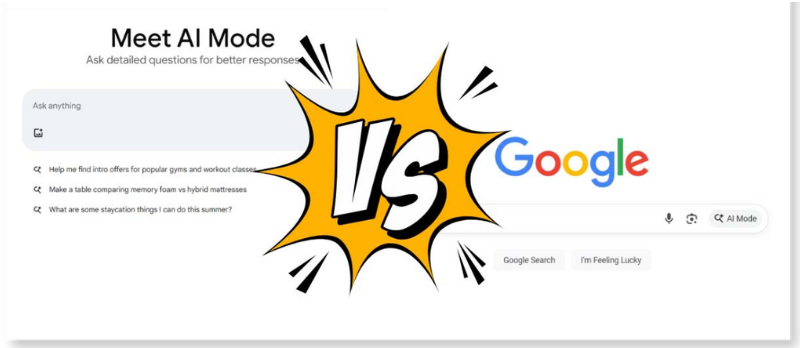
Search has changed. A lot.
Not long ago, finding a business online meant typing a few words into Google and clicking through a list of blue links. Now? People are asking full questions to tools like ChatGPT, Google’s AI Overviews, voice assistants and a bunch of other AI-powered search tools.
If you’ve asked ChatGPT a question, used voice search on your phone, or noticed Google answering things before you even click a website, you’ve already seen AI search in action. You’ve also seen that you get your answers instantly.
That’s great for users, but slightly terrifying for business owners. If AI can answer the question without visiting your website, where does that leave you?
The good news is that you’re not invisible yet. Ranking on the first page of Google is still important. SEO hasn’t gone anywhere, but it’s no longer enough on its own.
Learning how to optimise your website for both AI and Google search really matters. Let’s break it down in a way that won’t make your head explode.
What is AI search optimisation (and is it just another buzzword)?
You’ve probably heard a few different terms floating around:
- AIO – Artificial Intelligence Optimisation
- AEO – Answer Engine Optimisation
- GEO – Generative Engine Optimisation
Essentially, they’re the same thing. Instead of optimising your website purely to rank in the traditional and still important Google search results, you’re optimising it further so AI tools can understand it, trust it, and reuse it when answering questions.
The difference is that AI search tools:
- Interpret intent
- Analyse meaning and context
- Assess credibility
- Pull information from multiple sources
- Generate one confident answer
That means your website content now needs to act as a reliable source, not just a place people land after clicking a link.
How AI search differs from traditional SEO
Traditional SEO focuses on things like:
- Keywords and where they appear
- Metadata and headings
- Backlinks
- Ranking positions
- Driving clicks
You can read more about the traditional SEO strategies here.
AI search optimisation focuses on:
- Clear explanations
- Who you are and what you do (very clearly)
- Relationships between ideas
- Content that can be quoted or summarised
- Trust, consistency, and expertise
AI tools care less about who ranks first and more about who explains something best. That’s why well-written, well-structured website content is suddenly doing a lot of heavy lifting.
To optimise your website for AI search, you will need to start thinking differently about how the words on your website are written and structured. It’s important to write like a human, then edit for clarity. A good rule of thumb is to write naturally, remove filler words, cut anything that doesn’t add meaning, and replace buzzwords with plain English.
Write your website for questions, not just keywords
People don’t search the way they used to. Instead of typing “things to do in Northland”, they’re asking things like:
“What’s the best time of year to visit Northland?”
“What are the must-do experiences in Northland?”
“Is Northland good for families, couples, or adventure travellers?”
AI tools are built to answer questions. Your website should be too. Here are some tips for how to do this right.
- Turn your service descriptions into clear, question-based explanations
- Use subheadings that mirror real questions
- Answer directly and thoroughly
- Don’t hide the answer halfway down the page
- Be very clear about what you do (and what you don’t)
If a paragraph could be lifted out and still make sense as a complete answer, you’re on the right track. Remember that AI hates vague language. So do humans.
Phrases like “unforgettable adventures” or “world-class experiences” sound impressive, but they don’t really explain anything. Not to a human and not to a bot. If AI can’t clearly tell what your business does, it won’t confidently recommend you.
Instead, your website should:
- Name your services plainly
- Explain who they’re for
- Describe the outcomes
- Clarify what’s not included
Clarity helps AI categorise your business correctly, and it helps your ideal clients recognise that you’re a good fit. It’s important to structure your website so AI (and humans) can digest it. A clean structure makes it much easier for AI systems to extract useful information, and it makes your site far nicer to read as a bonus.
Good habits include:
- Clear H2 and H3 headings
- Short paragraphs (2–4 lines max)
- Bullet points where they make sense
- One idea per section
Try to avoid:
- Big long blocks of text
- Overly long paragraphs
- Cramming multiple ideas into one sentence
If your content feels easy to scan, you’re doing it right and depth beats waffle every time!
AI is surprisingly good at spotting generic content. If your website says the same things as every other business in your industry, it’s unlikely to stand out.
Strong, AI-friendly website copy shows real expertise through:
- Specific explanations
- Practical examples
- Industry knowledge (used properly, not sprinkled everywhere)
- Commercial awareness
This is especially important for professional services and B2B businesses. You don’t need hype. What you need is substance. If your content could apply to any industry with a few words swapped out, it’s not doing you any favours in AI search.
Build authority with connected content
One good page helps, but several related pages help much more. AI looks for consistency across your website. Blogs are great for this, but only when they’re written with purpose.
Topical authority comes from:
- Covering a subject from multiple angles
- Linking related pages together
- Using consistent language
- Reinforcing your expertise over time
For example, a web agency website like ours might include:
- A core page on website design
- An article on conversion-focused websites
- A blog on SEO fundamentals
- A blog on how to optimise your website for AI search
Together, this sends a strong signal about what we know and what we do well.
Use FAQs and summaries
Frequently Asked Questions are one of the easiest ways to help AI extract direct answers from your site. It’s also an incredibly useful resource for your clients. We can’t say it enough!
Effective FAQs:
- Ask real questions
- Give straight answers
- Skip the sales pitch
- Stay concise
Short summaries at the top or end of a page also help reinforce key points for both humans and AI systems.
Tech also matters for AI website optimisation
Great copy is one thing, but your website needs solid foundations. A few technical basics that support AI optimisation, and these are part of the package when you choose to work with Monster Creative, include:
- Clean HTML with correct heading structure
- Fast load times and mobile optimisation
- Schema markup to define things like your business, services, and articles
- Clear internal links between related pages
This is where the combination of strong copy, great design and good development earns its keep.
Getting your website ready for AI search
AI search is already shaping how businesses are discovered, compared and shortlisted. The websites that perform best won’t be the loudest or the most keyword heavy. They’ll be the clearest, most helpful, and most credible.
In short, what you need to do to optimise your website for AI search is explain what you do, answer real questions, and structure your content properly. That’s how your website is optimised for AI search and future proofed as search keeps evolving.
If you’re not sure where to start, or you think your website could do with a bit of an overhaul to make sure it’s optimised for AI search, the friendly team here at Monster Creative is always happy to help. Book a discovery call and let’s find out how AI-ready your website really is.